

Enough With the Panic: What the "No Screens, No Devices" Crowd Is Missing

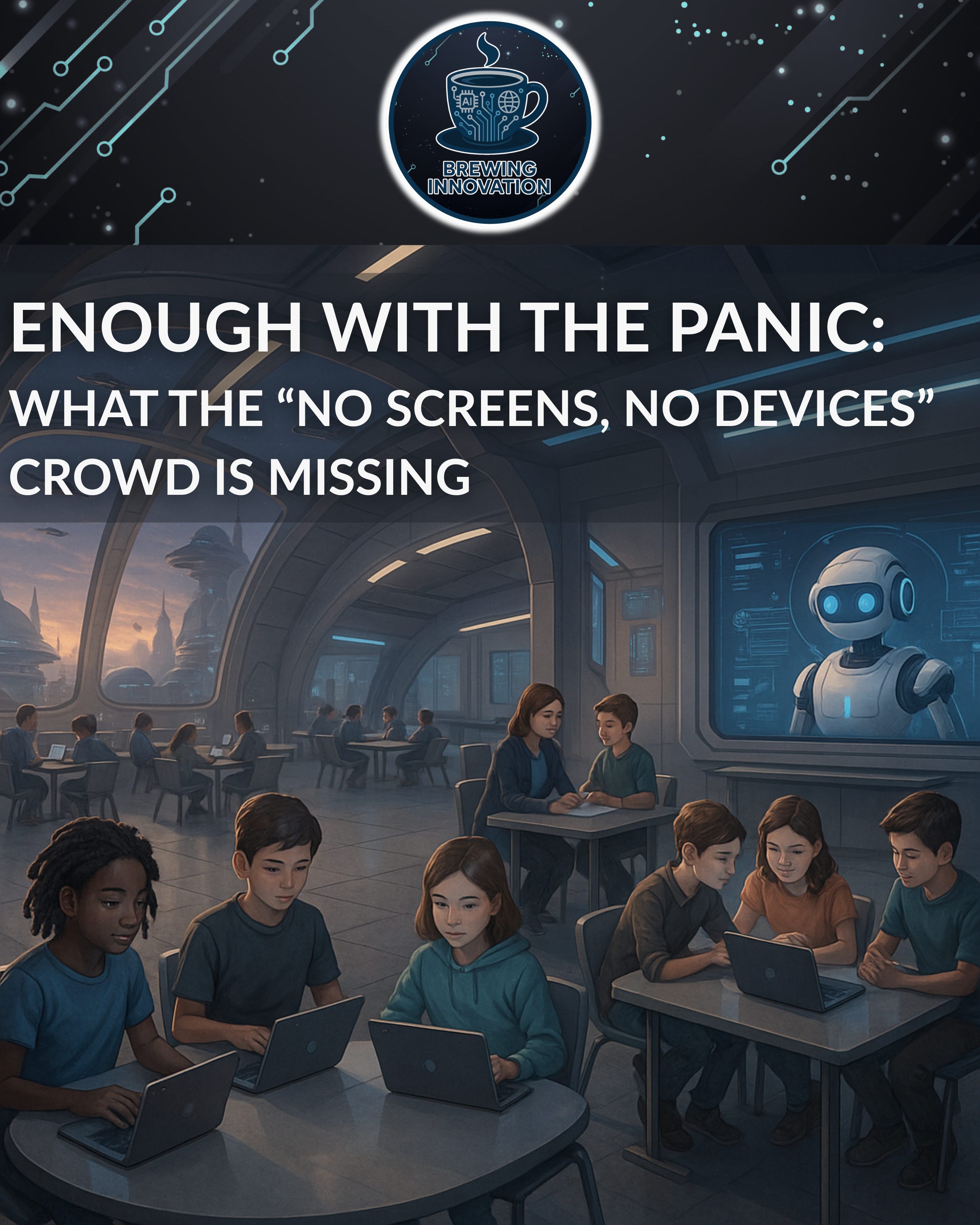
Lately, my feeds have been full of the same message:
“Ban laptops. Ban screens. Ban devices.”
Some posts go so far as to suggest that giving students technology “took away their brains.” Sound familiar? Matt Miller captured this wave perfectly in his newsletter this morning.
And look — I get it. I’m an assistant principal, a K–12 instructional technology leader, and a parent. I’ve seen the doom-scrolling. I’ve seen the fractured attention spans. I’ve seen the effects of unhealthy digital habits.
But here’s the thing the discourse keeps missing:
The problem is not technology. The problem is how we use it. And when used well, technology doesn’t take away student thinking, it amplifies it.
If we put a device in front of our students with no intention or systematic solution, it is no different than the parent that gives their child a tablet at the dinner table in a restaurant to keep them quiet. There’s a massive difference between giving kids devices… and giving kids purposeful, well-designed, teacher-led learning experiences that leverage technology to deepen thinking, expand access, and personalize support.
Let’s talk about that difference and what we lose when the louder voices push us toward all-or-nothing solutions.
Yes, There Are Real Concerns, But That’s Not the Whole Story
Matt lays out a mountain of evidence: mental health trends, sleep disruption, attention issues, and the rise of addictive platforms engineered to keep kids hooked.
None of that should be ignored.
But when critics take that research and jump straight to:
“Ban devices in classrooms,” they’re making the same mistake we made during remote learning and assuming the tech caused the problem rather than recognizing the absence of intentional design.
Unstructured screen time ≠ instructional technology.
YouTube doom loops ≠ guided learning.
TikTok ≠ blended instruction.
And anyone who has actually taught in a modern classroom knows the difference immediately.
Access Is Equity — Especially for Students With Disabilities
Before I was an administrator, I was a special education teacher in 15:1 classrooms.
Technology wasn’t “nice to have.” It was access.
Students who struggled with writing could speak their ideas through voice typing.
Students with processing disabilities could replay instruction, not just rely on one-time delivery.
Students who needed scaffolded text could get it instantly, without embarrassment or stigma.
Students with limited working memory could use organizational tools that kept them afloat.
I didn’t use tech to replace instruction. I used it to remove barriers. When people say “ditch the devices,” I hear:
“Let’s take away the tools that help students who need them most.”
That’s not equity. That’s nostalgia masquerading as pedagogy.
Catlin Tucker Showed Us the Blueprint for Doing This Well
If you’ve ever implemented Catlin Tucker’s blended learning strategies, especially station rotation, you know exactly how powerful instructional technology can be when framed through sound pedagogy.
Blended learning didn’t make my classroom more digital; it made it more human, because technology handled the tasks that didn’t need me:
Differentiated practice at one station
Teacher-led small groups at another
Collaborative work that required students to think, create, and reflect
Tech wasn’t the star of the show. It was the infrastructure that made personalization possible. Catlin’s work has become foundational for educators across the country for a simple reason:
Blended learning gives students more voice, more choice, more agency — and gives teachers more time where it matters most.
We don’t need less of that. We need more.
Binary Thinking Helps No One
Matt calls this out directly: the loudest arguments fall into all-or-nothing thinking — “Ban it all” or “Tech is the enemy.”
But teaching has never been all-or-nothing. It’s always been artful decision-making.
Just look at my own practice (and his):
Some things belong on paper.
Some things belong on Chromebooks.
Some things belong in conversation.
Some things belong in AI-supported tools.
Good teaching is, and has always been, the act of choosing the right tool at the right time for the right purpose. Devices don’t change that. AI doesn’t change that. Pandemic-era trauma doesn’t change that. In fact, the nuance matters now more than ever.
What the Viral Arguments Get Wrong — Let’s Look at the Actual Examples
Matt Miller highlighted several of the exact arguments fueling this “ban the tech” argument and when you look closely, they all share the same flaw: they oversimplify complex problems into a catchy headline.
Here are the big three he calls out, and the nuance they ignore:
1. “Ban laptops — handwriting leads to deeper learning.”
Matt cites Adam Grant’s viral post arguing that laptops should be removed from classrooms because students supposedly “learn more and get better grades” when taking notes by hand.
But this argument makes a huge leap: Better retention with handwritten notes does NOT mean laptops have no place in learning.
Notetaking is just one small slice of classroom practice. Laptops also support:
accessibility tools
project-based learning
collaborative writing
guided practice with instant feedback
AI-supported revision and coaching
The conclusion shouldn’t be “ban laptops.” It should be “teach students when to hand-write and when to type.” That’s called instruction, not elimination.
2. “We gave students laptops and took away their brains.”
Matt includes a screenshot from a TikTok video claiming that screens have destroyed cognitive stamina, citing the book Digital Delusion as evidence. Digital Delusion does raise important concerns about passive screen consumption and we should take those seriously. But here’s the nuance missing from the viral take:
Digital Delusion critiques unstructured, unsupervised, entertainment-driven screen use — not purposeful instructional technology.
There is a world of difference between:
an hour of TikTok
and an hour of blended learning where students rotate between small-group instruction, targeted practice, and collaborative problem-solving.
Screens aren’t the villain. Unstructured consumption is. And it’s our responsibility to teach students the difference.
3. “AI will destroy critical thinking.”
This one is everywhere — and Matt hits the nail on the head. The viral argument assumes students will only ever use AI to shortcut thinking. But that assumes the worst, not the possible.
In reality, when used intentionally, AI can:
scaffold struggling readers
provide alternative explanations
help students rehearse ideas before writing
act as a study partner
free teachers to spend more time in small groups
differentiate instruction in ways impossible before
AI isn’t replacing thinking. It’s replacing busywork so students can think.
The Pattern Is Clear: The Issue Isn’t Tech, It’s Oversimplification
Each of these arguments:
Starts with a real concern
Applies all-or-nothing thinking
Ends with a blunt solution that removes tools instead of improving teaching
As Matt writes, we don’t need sledgehammers — we need scalpels. We need intentional, thoughtful design, not bans. Even Digital Delusion, when read in full, doesn’t argue for eliminating instructional technology. It argues for better habits, clearer boundaries, and healthier relationships with screens, exactly what schools should be teaching in the first place.
What We Should Be Fighting For
This isn’t a moment to ban devices.
It’s a moment to invest in teacher skill, instructional design, and healthy tech habits.
Here’s what our schools actually need:
1. Pedagogy-First Tech Integration
Tech should never be the driver. Pedagogy leads; tools follow.
2. Clear Routines and Guardrails
Students need structure around screen use, just like they need structure around everything else in school.
3. Media Literacy and AI Literacy for All
Because students don’t need less technology, they need smarter, healthier, more empowered relationships with technology.
4. Professional development that treats teachers as designers, not device managers
We should be helping teachers make intentional choices, not mandating tools or banning them.
5. A culture where tech is a scalpel, not a sledgehammer
Matt’s metaphor is spot on: we need precision, not blunt-force rules.
Let’s Stop Pretending That Banning Devices Solves the Problem
Removing laptops doesn’t magically:
improve mental health,
fix instructional gaps,
rebuild attention spans,
or prepare students for the world they’re walking into.
But empowering teachers to design learning that is:
active
reflective
collaborative
blended
human-centered
…that does make a difference.
We don’t need a tech ban.
We need better teaching supported by thoughtful technology use.
That’s the work. And it’s work worth doing.
Stay Curious. Stay Caffeinated. ☕

Awesome post. Like most of the difficult questions that I face as a father (and that I'm sure other parents also do), the answer is rarely a flat yes or no. Thanks for offering more nuanced insights into the debate!
Fully recognise this. It’s almost as if we as teachers need to intentionally design learning experiences with all the tools at our disposal….🤦♀️